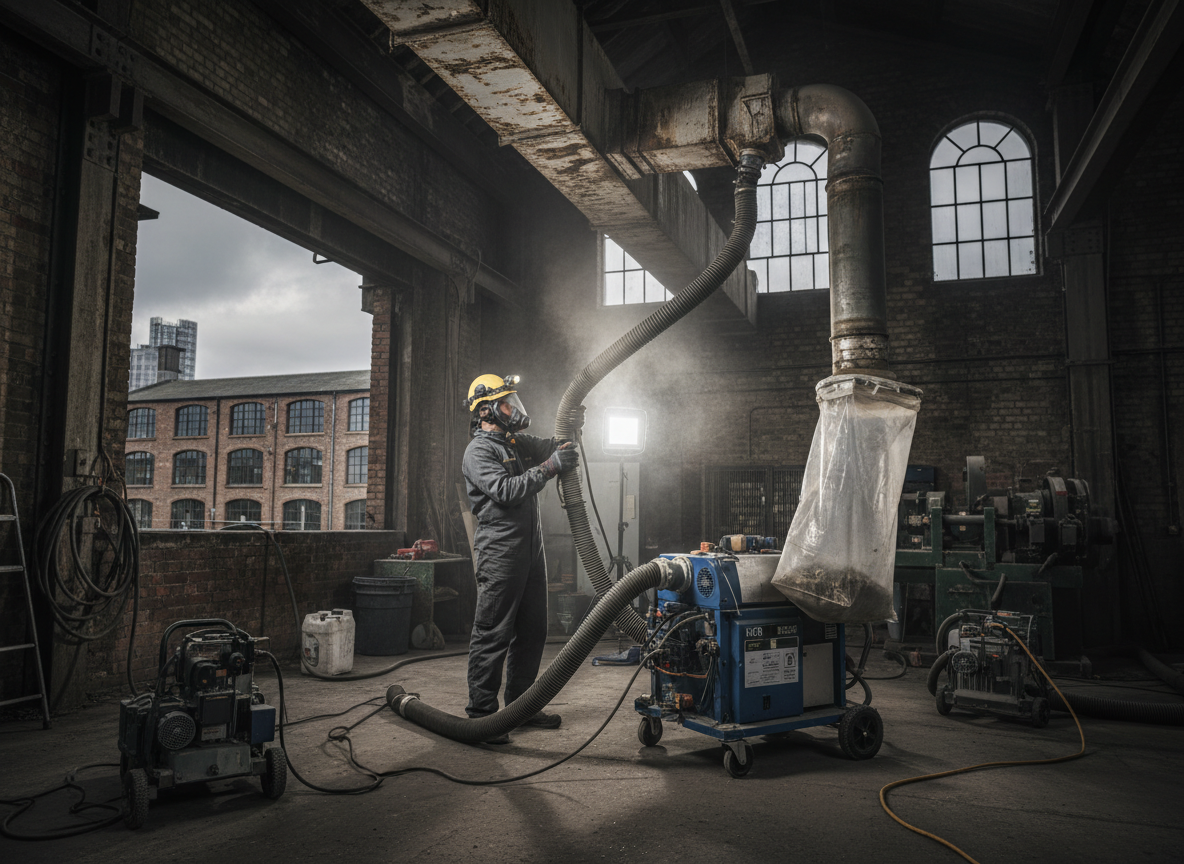
Manchester homes built before 1970 often have rigid metal duct runs that trap construction debris and insulation fibers for decades. When a sudden event like a basement backup or attic insulation breach occurs, those particles circulate through every room within hours. Emergency service starts with isolating affected branches using temporary caps so the rest of the system stays usable while the contaminated sections are agitated and extracted. Technicians carry portable HEPA units sized for the narrow 6-inch and 8-inch trunks common in Cape-style houses on the west side of town.
Winter temperature swings in Manchester drive condensation inside ducts that run through unheated crawl spaces along the Merrimack. When that moisture meets dust, colonies of mold can release spores into living areas overnight. An emergency call requires checking supply and return plenums first because those chambers hold the largest volume of settled material. Crews use forward-curved brushes matched to duct diameter to avoid denting older galvanized pipe while still breaking loose the biofilm layer that standard vacuuming leaves behind.
After any fire or heavy cooking smoke event, residents notice a sharp odor that returns within days if the ducts are not addressed. The fine soot particles embed in the seams of rectangular ductwork found in many split-level homes near Bridge Street. Emergency protocol includes removing and cleaning the blower wheel and evaporator coil housing on site because those components re-contaminate cleaned ducts within one cycle. All debris is bagged and removed before the system is reassembled and tested for static pressure to confirm no new restrictions were introduced.
Technician insight
In Manchester the thing that catches most people out with Emergency Air Duct Cleaning is the narrow rectangular ducts in 1950s capes along the North End that were never built with cleanouts; once insulation fibers from an attic breach get in there, you cannot reach the blockage without cutting access panels that homeowners rarely expect.
Attic insulation breach after ice dam
Cellulose insulation poured into a second-floor return through a roof leak during a March thaw. We isolated the affected branch, extracted the wet material, and cleaned the main trunk serving the first floor. Homeowners regained normal airflow without replacing any duct sections.
How it works
- 1
Initial Assessment
Technician arrives, isolates the affected zone, and maps duct layout using existing access points.
- 2
Containment Setup
Negative-air machines and sealed barriers prevent cross-contamination to unaffected rooms.
- 3
Agitation and Extraction
Brushes and compressed air move debris to the vacuum collection point without damaging older duct seams.
- 4
Final Verification
System is reassembled, airflow is measured, and a post-service walkthrough confirms odor and debris removal.
Pricing
Emergency response carries a dispatch premium that scales with time of day and system complexity; an upfront quote is given before work begins.