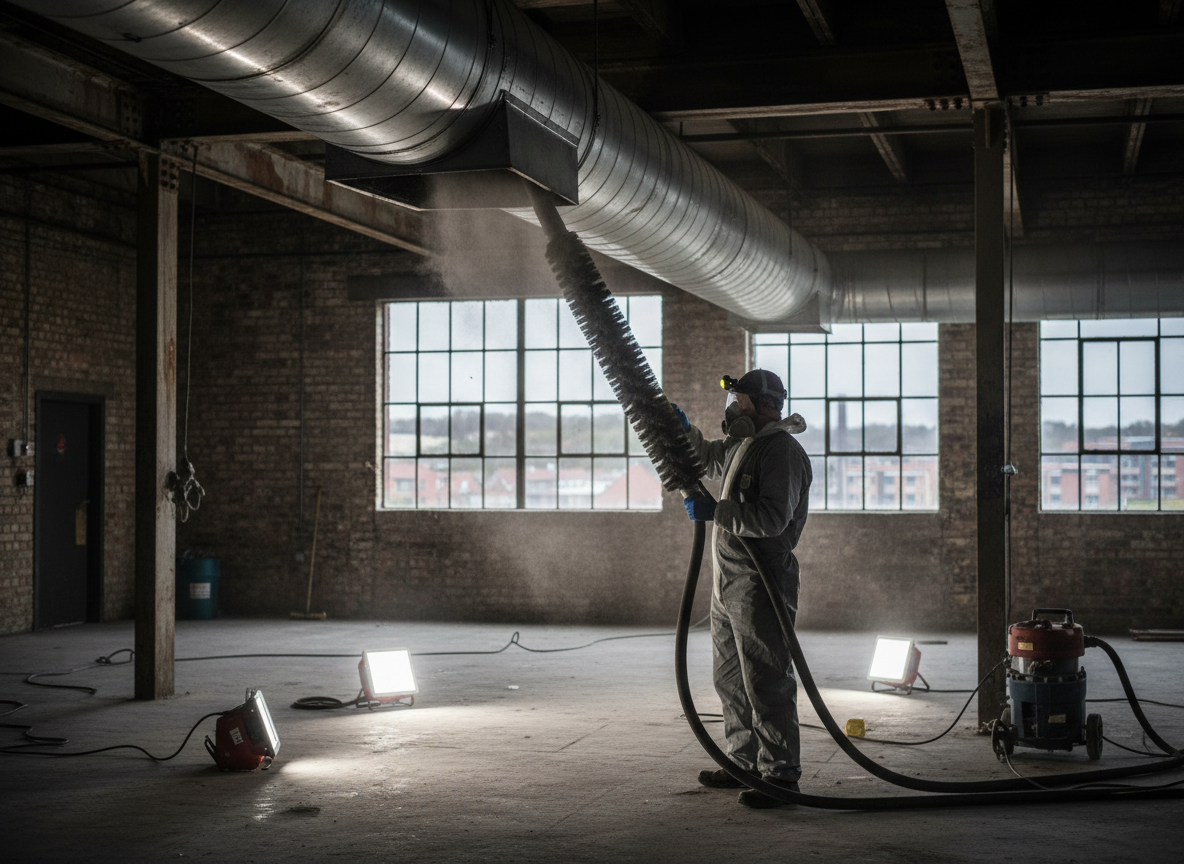
Commercial properties in Manchester and Ocean County often feature older rooftop units and extended duct runs that accumulate dust, insulation fibers, and construction residue over decades. These systems run longer hours than residential ones, so restricted airflow raises energy costs and spreads particulates through occupied spaces. Technicians must map out multiple zones, isolate sections with dampers, and use negative-air machines sized for higher CFM to avoid cross-contamination between tenant areas.
Access challenges appear frequently in Manchester strip plazas and light-industrial buildings where ducts run above drop ceilings or through tight mechanical rooms. Removing grease-laden buildup from kitchen exhaust branches connected to the main supply requires separate agitation tools and HEPA filtration to meet local fire-code expectations without shutting down adjacent businesses. Edge cases include flexible duct sections that can collapse under vacuum if not supported properly during cleaning.
Seasonal humidity swings in the Manchester area allow mold to form on interior duct walls when condensate drains clog, especially in buildings with older single-ply roofing. Crews inspect for these conditions first, then apply only EPA-registered antimicrobial treatments where visible growth exists rather than as a blanket spray. Post-clean verification includes static pressure readings at supply and return points to confirm restored airflow before the system returns to normal operation.
Technician insight
In Manchester, the thing that catches most people out with Commercial Air Duct Cleaning is the long horizontal runs above suspended ceilings in 1980s-era strip centers along Route 70. Those sections sag and trap debris that standard residential tools miss, so you end up spending extra time supporting the flex duct before you can even start agitation.
Retail Plaza HVAC Restoration
A Manchester retail plaza reported uneven cooling and visible dust on merchandise. Inspection found collapsed flex duct sections above the ceiling grid holding years of construction dust. We supported the runs, agitated the full trunk, and extracted material through a roof-mounted collector. Airflow readings improved and the tenant spaces stayed open throughout the work.
How it works
- 1
Site Assessment
Walk the property to locate all air handlers, map duct routes, and identify access points without disrupting business hours.
- 2
Zone Isolation
Seal off individual HVAC zones and set up negative-air containment to prevent dust migration between tenant spaces.
- 3
Mechanical Agitation
Use rotary brushes and compressed-air whips sized for commercial duct diameters to loosen debris along the full run.
- 4
Extraction and Verification
Pull loosened material through HEPA-filtered collectors, then take post-clean static pressure readings to confirm airflow restoration.
Pricing
Pricing depends on total duct length, number of air handlers, and access difficulty in Manchester commercial buildings.