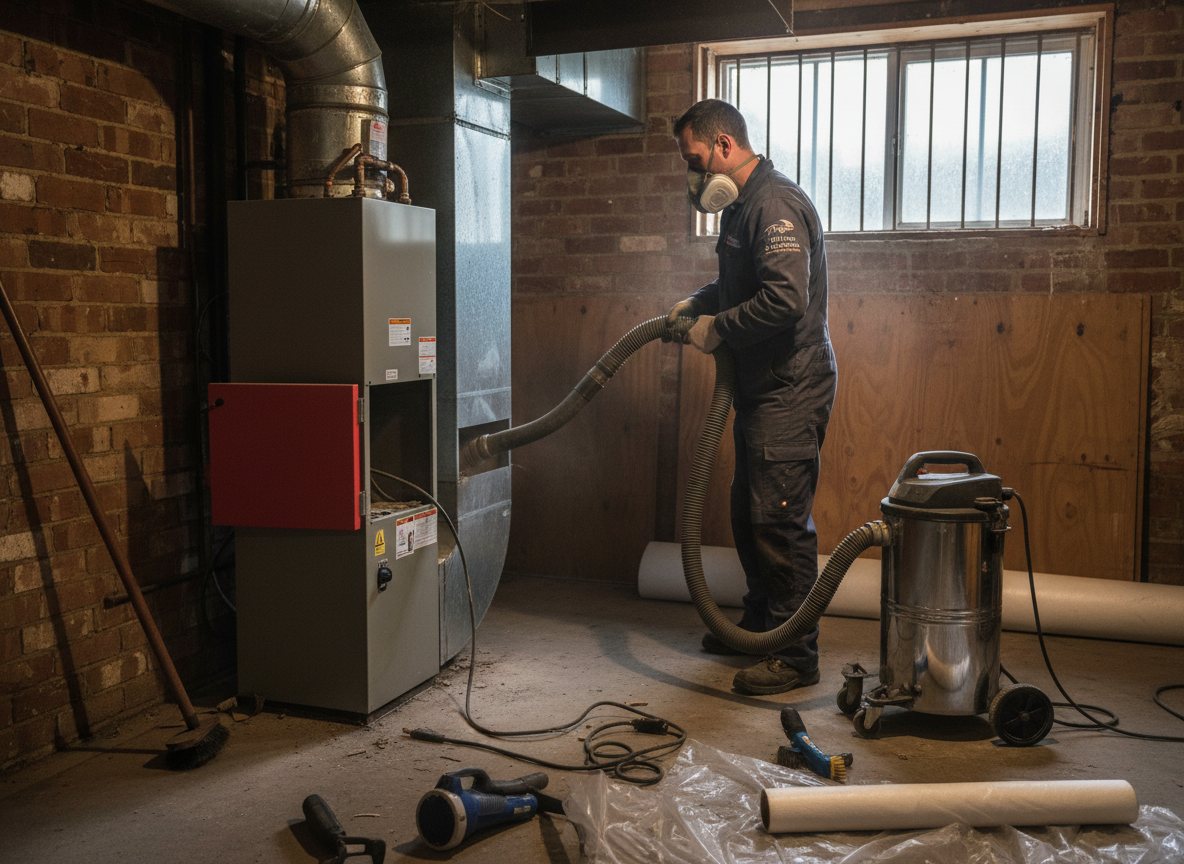
Manchester's housing stock includes many mid-century homes with original duct runs that trap fine dust and insulation fibers over decades. Furnace and duct cleaning here requires accessing narrow returns behind finished basements and navigating shared walls in multi-family buildings common along Bridge Street corridors. Cold winters drive longer furnace cycles that push settled debris through registers, so crews often start by mapping each trunk line before any agitation begins.
Oil and gas furnaces prevalent in the Manchester area leave behind soot that bonds to duct interiors when humidity spikes during shoulder seasons. Technicians use negative-air machines rated for the volume of these older systems to prevent cross-contamination into living spaces. Edge cases include asbestos-wrapped pipes in pre-1970 homes near the Merrimack River, where containment protocols must be followed before any brushing or vacuuming occurs.
Homeowners frequently overlook the furnace cabinet itself, yet that is where most airflow restriction starts in Manchester winters. Proper cleaning includes removing the blower assembly, vacuuming the heat exchanger exterior, and checking for gaps in the plenum that allow unfiltered air to bypass filters. These steps reduce strain on aging equipment common in the city's established neighborhoods.
Seasonal Considerations
Winter demand peaks after the first hard freeze when residents notice uneven heating. Spring cleanings catch pollen pulled in through attic returns during milder months. Scheduling before November avoids the rush that can leave systems partially cleaned when temperatures drop.
Technician insight
In Manchester, the thing that catches most people out with furnace and duct cleaning is how many 1950s-1970s homes have returns routed through finished ceilings with no access panels. Once winter temperatures drop and the furnace runs nonstop, that hidden dust gets pushed into every room and homeowners assume the ducts are the only problem.
West Manchester Cape Cod Job
Homeowner reported weak heat on the second floor. Inspection found the return chase blocked by accumulated fiberglass and pet hair from the original 1962 ducts. After isolating the system and extracting material from the trunk behind the knee-wall, airflow returned evenly and the furnace cycled normally.
How it works
- 1
Initial Assessment
Technician inspects furnace, registers, and accessible duct runs to identify access points and any visible obstructions in Manchester homes.
- 2
System Isolation
Registers are sealed and negative pressure is established to contain debris during agitation of the main trunk lines.
- 3
Agitation and Extraction
Rotary brushes and compressed air dislodge buildup while the vacuum removes material from the furnace cabinet and ducts.
- 4
Final Inspection
Each section is checked with a camera, filters are replaced if supplied, and airflow is verified before restoring normal operation.
Pricing
Cost depends on number of runs, furnace location, and access difficulty; upfront quotes provided after inspection.