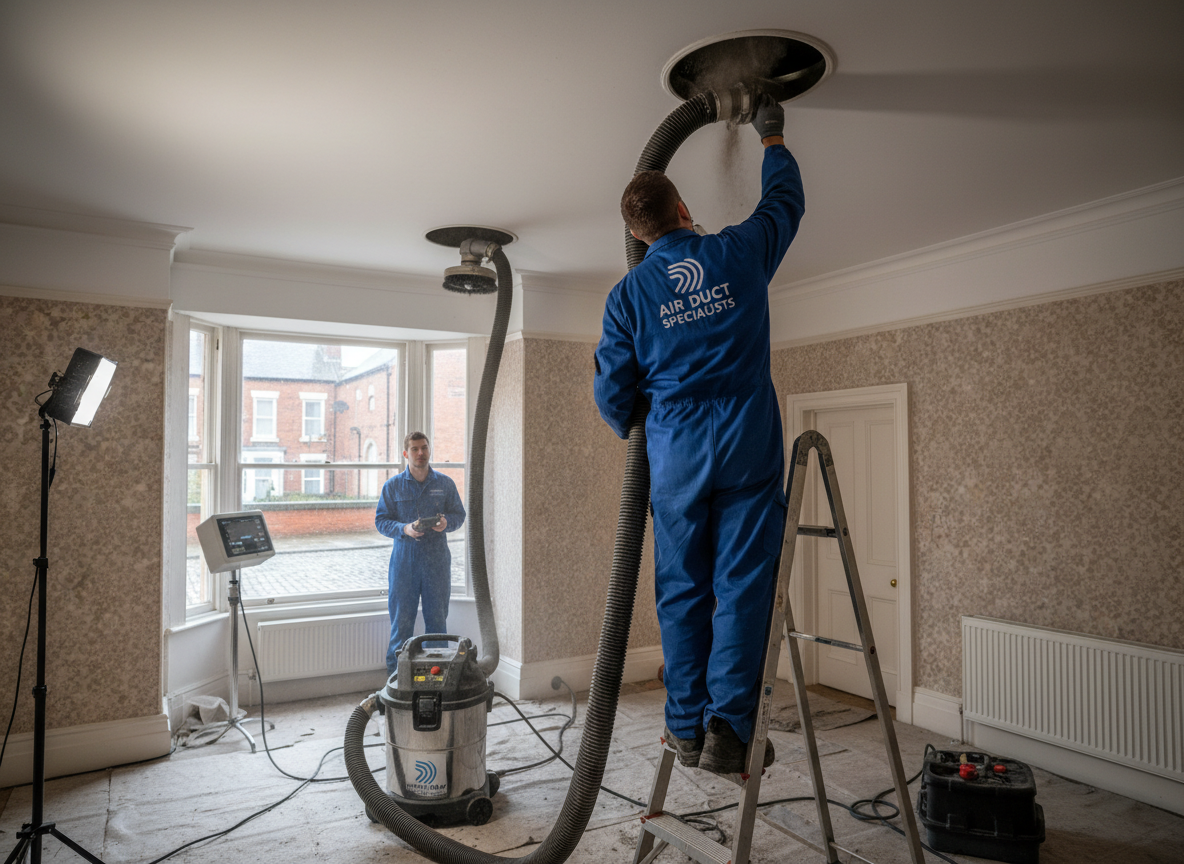
Whole house air duct cleaning in Manchester requires attention to the mix of ranch-style and split-level homes common throughout the township and nearby Ocean County neighborhoods. Rigid metal trunks often run through basements or crawl spaces while flexible branch lines feed individual rooms, and years of seasonal use can pack lint and insulation fibers into the seams where sections meet. Accessing these junctions without disturbing insulation or creating new gaps demands careful disassembly and re-sealing that only comes from repeated work on the same local housing stock.
Technicians must also watch for the effects of high summer humidity and occasional coastal salt air that accelerate corrosion on older galvanized ducts. In homes built before the 1990s, paper-backed insulation wrapped around ducts can shed fibers into the airstream once it degrades, creating a secondary contamination source that standard vacuuming alone will not remove. Proper negative-pressure equipment and HEPA filtration keep loosened material from re-entering living spaces during the process.
Before any cleaning begins, supply and return runs are mapped from the air handler outward so every branch receives agitation and extraction. Registers are removed and cleaned separately, and the furnace or air-handler blower housing is opened to clear the wheel and coil surfaces that often trap the heaviest buildup. Final inspection includes a visual check of each cleaned section and a test run of the system to confirm airflow returns to normal levels without new leaks.
Technician insight
In Manchester, the thing that catches most people out with whole house air duct cleaning is the way older split-level homes in the township route flexible duct through tight knee-wall spaces that standard brushes cannot reach without kinking the line. Homeowners often assume a quick vacuum from the register is enough, but those hidden bends hold the bulk of the buildup until the sections are actually opened.
Split-Level Home in Manchester Township
A Manchester homeowner noticed reduced airflow and musty odors after a wet spring. Mapping showed flexible duct runs pinched in knee-wall cavities behind finished walls. Sections were carefully opened, debris extracted under negative pressure, and lines resealed. Airflow returned to normal and the odor disappeared.
How it works
- 1
Initial System Mapping
Technicians trace every supply and return run from the air handler through Manchester homes, noting access points and any flexible duct sections that need special handling.
- 2
Register and Component Removal
All registers are taken off and cleaned off-site while the blower housing and accessible coils are opened for direct extraction.
- 3
Negative-Pressure Cleaning
HEPA-filtered equipment creates suction while agitation tools loosen debris along the full length of each duct run.
- 4
Reassembly and System Test
Ducts are resealed, registers reinstalled, and the HVAC system is run to verify restored airflow and confirm no new gaps were introduced.
Pricing
Pricing varies with home size, number of runs, and condition of the ductwork; contact Home Revix for an upfront assessment.