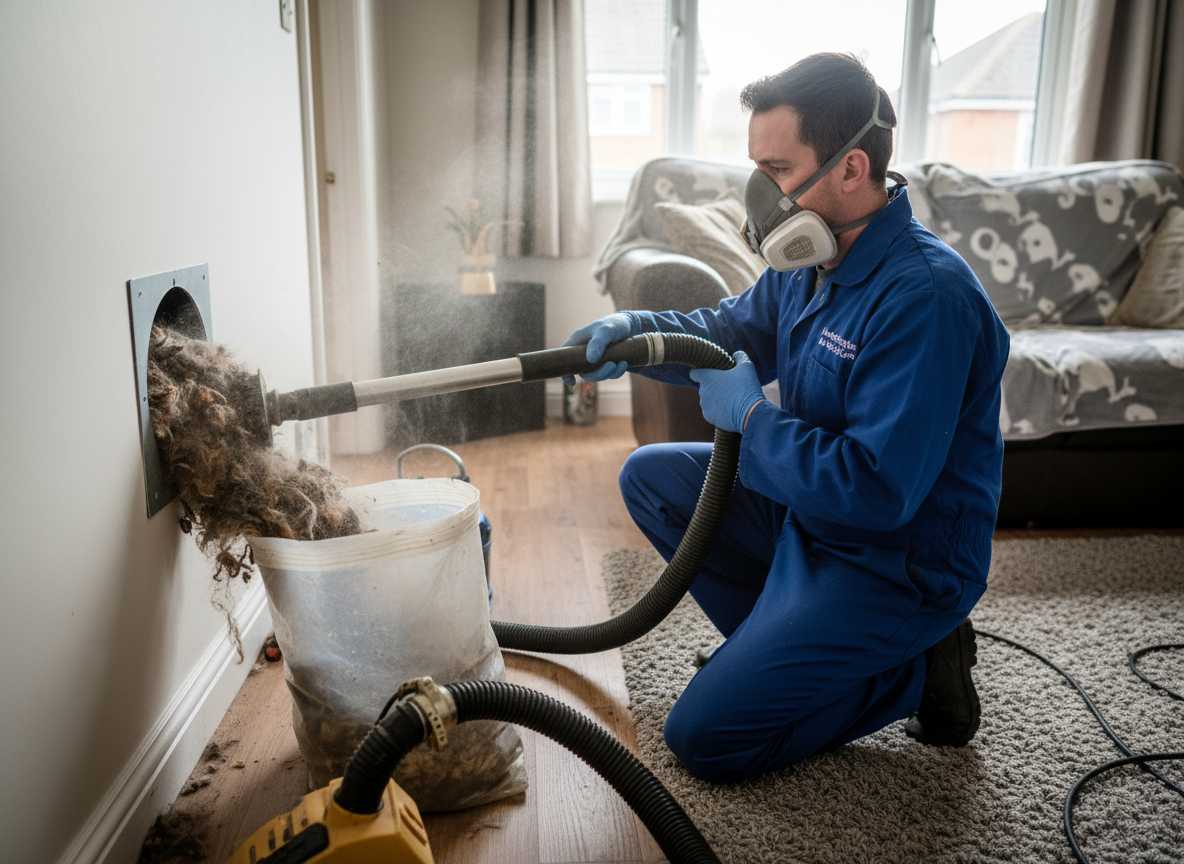
Pet hair and dander accumulate quickly in Manchester homes built from the 1960s onward, especially in single-story ranches common around Pine Lake Park and Leisure Village. These fine particles travel through the return plenum and lodge in the flex duct runs that many local HVAC systems still use. Standard vacuuming misses the matted layers along the bottom of the main trunk lines, allowing the material to recirculate every time the system cycles during humid summer months.
Technicians begin by mapping each branch run from the air handler outward, noting 90-degree elbows where pet hair packs tightest. A combination of rotary brushes sized for 4-inch and 6-inch lines agitates the buildup without tearing the older duct liner found in many Manchester properties. Negative-air machines capture the loosened material at the source so it does not enter living spaces, and every register is removed and cleaned separately to prevent reintroduction of hair when airflow resumes.
After cleaning, the team checks static pressure at the air handler to confirm improved flow. Homes with multiple pets or long-haired breeds often require a second pass on the return side, particularly when the filter has been bypassed or left unchanged through winter. This step prevents the rapid re-soiling that occurs when pet hair bypasses a clogged filter and settles back into the coils.
Homeowners are advised to replace or upgrade to a MERV-13 filter immediately after service and to schedule follow-up visits before the next heating season, when closed windows keep airborne dander circulating longer.
Technician insight
In Manchester the thing that catches most people out with pet hair duct cleaning is the narrow, lined flex runs in 1970s Leisure Village homes that trap hair right at the 90-degree turns near the slab; once it mats there, standard shop-vac attachments never reach it and the problem returns within weeks.
Pine Lake Park ranch with two golden retrievers
Homeowners noticed dust and hair reappearing on surfaces within days of filter changes. Inspection showed heavy matting in the return trunk and two collapsed flex elbows. Rotary brushes and negative air cleared the buildup; new MERV-13 filters and straightened runs restored airflow and eliminated visible hair on registers.
How it works
- 1
System Mapping
Locate every supply and return run from the air handler, noting duct material and access points typical in Manchester homes.
- 2
Register and Vent Removal
Remove all floor and wall registers, clean behind them, and seal openings to contain debris during agitation.
- 3
Agitation and Extraction
Use rotary brushes and negative-air equipment to dislodge and capture pet hair from trunk lines and branches.
- 4
Final Inspection and Filter Advice
Verify airflow improvement and recommend appropriate filter changes for homes with multiple pets.
Pricing
Cost depends on number of runs, duct access, and pet count; upfront quotes provided after inspection.