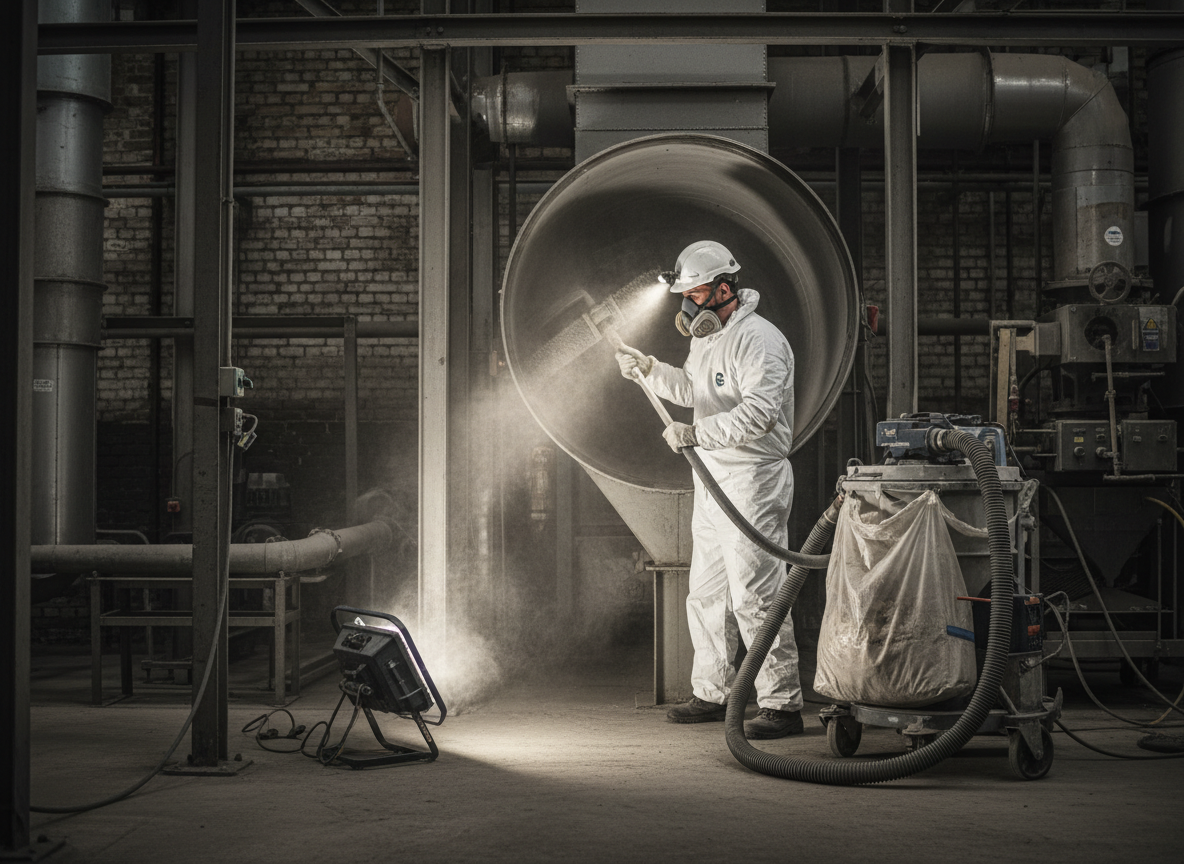
Industrial air duct systems in Manchester often run through older manufacturing buildings and warehouses with long horizontal runs and multiple branch lines. These setups collect fine metal particles, insulation fibers, and process dust that standard residential equipment cannot reach. Proper cleaning requires negative-air machines rated for high cubic feet per minute and sectional brushes sized to each duct diameter to avoid damaging seams or insulation.
Access points are frequently limited in Manchester industrial parks because equipment is mounted above production lines or in tight mechanical rooms. Technicians must coordinate shutdowns with facility managers to prevent downtime. In buildings near Route 70 or the Manchester industrial corridor, vibration from nearby traffic can loosen accumulated debris, making pre-clean inspections essential to locate loose sections before full extraction begins.
Edge cases include ducts that pass through unconditioned attics or crawl spaces where temperature swings cause condensation and mold growth on interior surfaces. In these situations, antimicrobial application follows mechanical cleaning only after all visible debris is removed. Crews also check fire dampers and smoke detectors to ensure they remain functional after service.
Regulatory notes for Manchester jobs include confirming that cleaning does not violate any local fire-code requirements on damper operation. Homeowners and facility managers should plan for at least one full day of access and verify that all registers and returns are marked before work starts.
Technician insight
In Manchester the thing that catches most people out with industrial air duct cleaning is the long, low-slope runs in older warehouse buildings along the Route 70 corridor. Those runs trap fine process dust that only moves when you hit the right combination of brush speed and negative pressure; miss the angle once and you leave a streak that shows up on the next inspection.
How it works
- 1
Site Assessment
Walk the full duct layout, note access points, and measure duct sizes to select correct equipment.
- 2
Isolation and Containment
Seal sections of the system and set up negative air to prevent dust migration into occupied spaces.
- 3
Mechanical Agitation
Use rotating brushes and air whips sized for industrial diameters to dislodge debris from all interior surfaces.
- 4
Extraction and Collection
Pull loosened material into sealed collection units with HEPA filtration rated for the expected load.
- 5
Final Inspection
Verify cleanliness with cameras and confirm dampers and sensors remain operational before restoring airflow.
Pricing
Pricing depends on total linear feet of duct, number of access points required, and whether the system must be shut down during business hours.