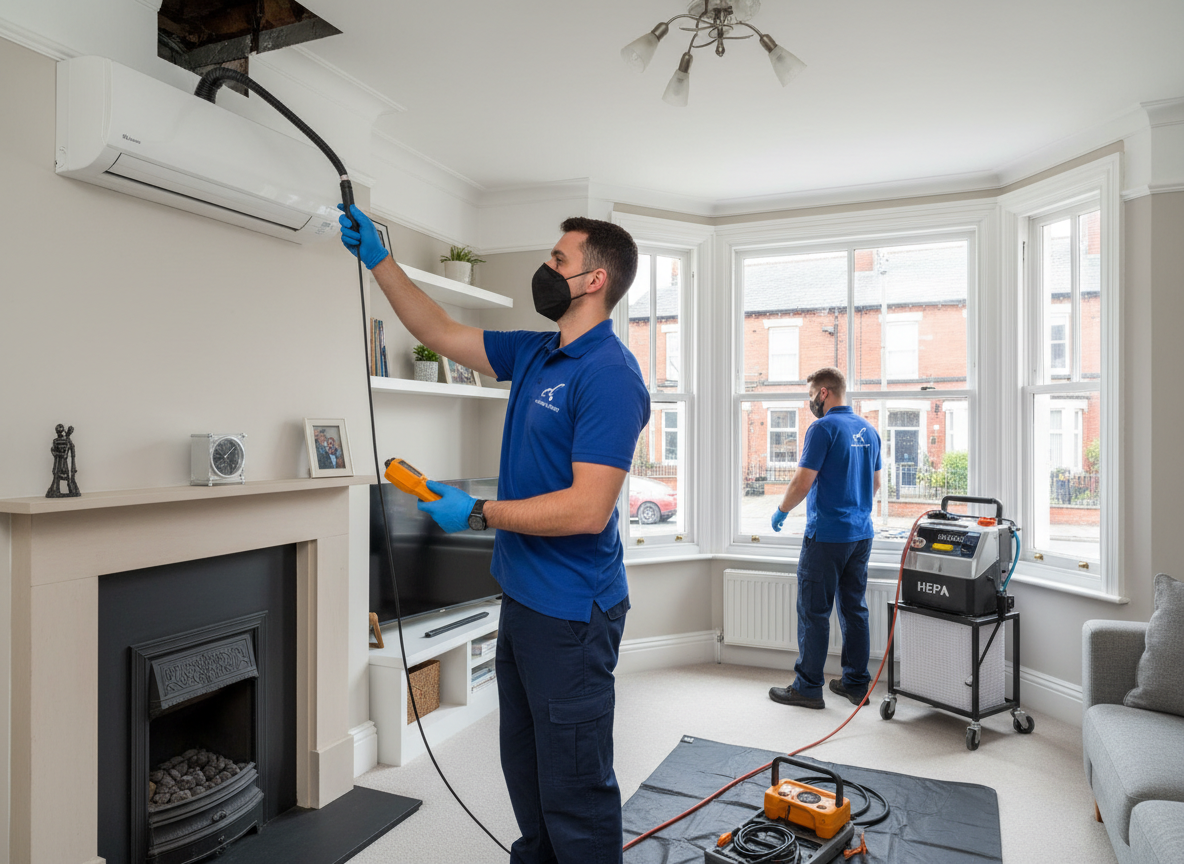
Manchester homes built before 1980 often have single-layer ductwork that collects fine construction dust and insulation fibers over decades. Cold winters drive furnaces to run longer, pushing that material through every vent and raising respiratory irritation for residents. We inspect for disconnected runs, crushed flex lines, and buildup near the plenum where airflow slows. Removing the debris restores even pressure without disturbing the original sheet-metal joints.
Humidity swings in the Manchester area create condensation inside supply ducts during shoulder seasons. That moisture mixes with dust to form a film that restricts airflow and feeds mold spores. Our process includes checking for proper insulation wraps on ducts that run through unconditioned spaces like attics and crawl spaces common in South Manchester neighborhoods. Addressing these spots prevents repeat growth after cleaning.
We also map return-air pathways in split-level homes near the Merrimack River, where older floor returns pull air from basements that hold seasonal moisture. Sealing gaps and cleaning these returns cuts cross-contamination between living areas and lower levels. Every job ends with a post-service airflow check so homeowners can verify the difference themselves.
Homeowners sometimes confuse indoor air quality work with simple filter changes, yet the real restriction usually sits deeper in the trunk lines. We document before-and-after static pressure readings so the improvement is measurable rather than assumed.
Technician insight
In Manchester, the thing that catches most people out with indoor air quality services is the older ranch and split-level homes near the river where cold winters pack dust into long horizontal runs that never get proper airflow. Homeowners keep changing filters yet never reach the buildup sitting in those low trunk lines.
Hidden Blockage in South Manchester Ranch
A homeowner noticed uneven heating on the main floor. Inspection found crushed flex duct under the kitchen floor pulling basement air. We opened two access points, cleared the line, and restored balanced pressure across all registers.
How it works
- 1
Initial Walk-Through
We examine every accessible duct run, register, and the furnace or air handler while noting home age and layout.
- 2
Access Point Setup
Small openings are created at strategic points to reach the main trunk without cutting finished ceilings.
- 3
Negative-Pressure Cleaning
HEPA-filtered equipment pulls debris from the entire system while brushes agitate settled material inside the ducts.
- 4
Final Verification
We recheck static pressure, close access points, and walk the homeowner through the results.
Pricing
Pricing depends on number of stories, duct material, and how many access points are needed.