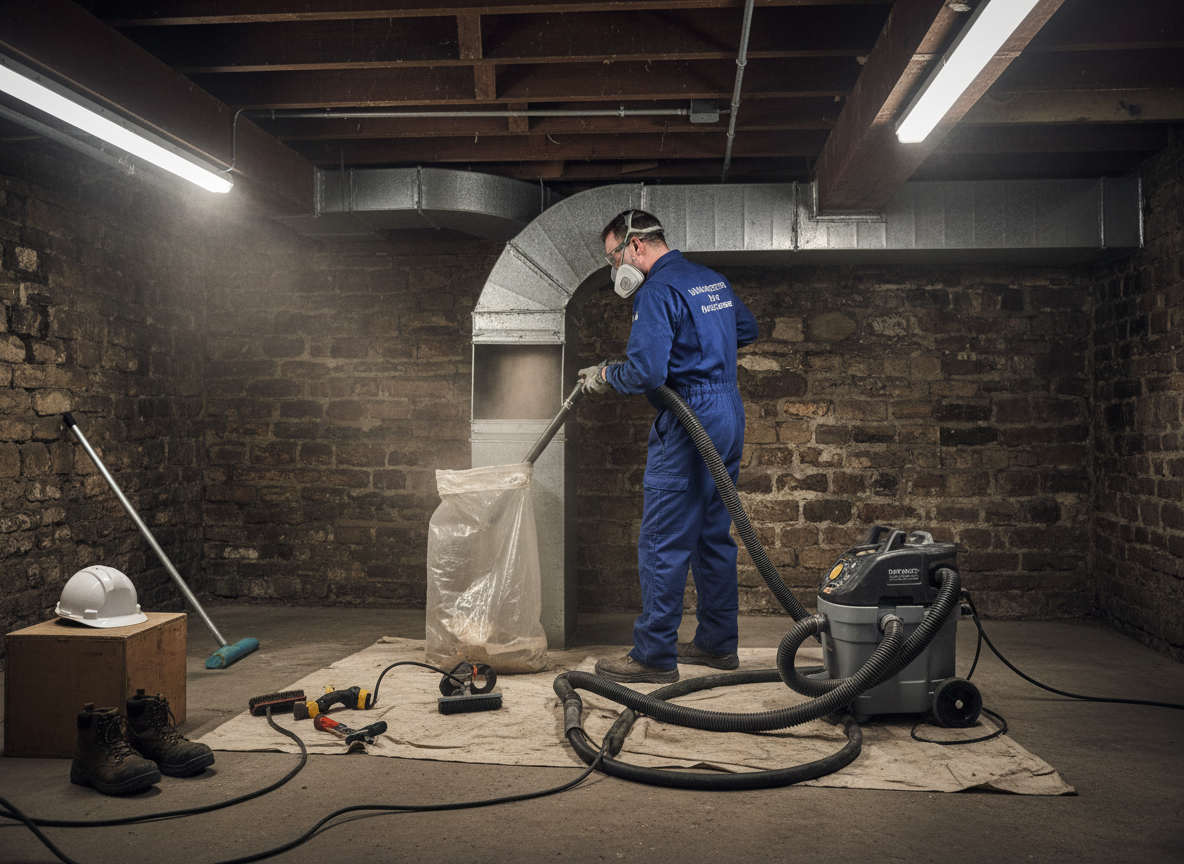
Basement air duct cleaning in Manchester requires extra care because many homes sit on older foundations where ducts run close to concrete floors and walls that retain moisture. Technicians must first map the layout to locate sections hidden behind finished walls or low ceilings common in Ocean County properties. Equipment includes negative-air machines and rotary brushes sized for tight 6- to 8-inch runs that often collect construction debris left from original builds. Skipping these hidden stretches allows dust to recirculate into living areas above.
High water tables in parts of Manchester mean basement ducts can develop condensation during humid summer months, leading to heavier buildup than in upper floors. Cleaning crews isolate the system, seal registers, and use HEPA filtration to prevent particles from escaping into the basement itself. Access panels may need temporary removal in older ranch-style homes where ducts were installed before current code requirements for cleanouts. Homeowners should expect the job to take longer when ducts travel under poured slabs or through crawlspaces that stay damp year-round.
After mechanical cleaning, each register and boot is inspected for remaining residue because basement returns pull air from the lowest point in the house. Technicians document before-and-after conditions with photos so owners can see the difference in the metal surfaces. This step is especially useful in Manchester neighborhoods where homes from the 1960s and 1970s still have original galvanized ductwork that shows visible corrosion once cleaned.
Technician insight
In Manchester, the thing that catches most people out with basement air duct cleaning is how often ducts run under or along the slab in homes built before the 1980s. Once you open the first access point you find the line drops below grade and fills with fine sand that the vacuum has to handle separately.
Hidden Slab Duct in Manchester Basement
Homeowner noticed musty air only on the first floor. Inspection showed the main return traveled under the basement slab. Crew opened two access points, removed accumulated sand and dust, then restored airflow without cutting finished walls.
How it works
- 1
System Mapping and Access Check
Technicians locate every run in the basement, noting low-clearance areas and any finished surfaces that must be protected before work begins.
- 2
Isolation and Containment
Registers are sealed and negative pressure is established so debris stays inside the ducts and does not enter the basement living space.
- 3
Mechanical Cleaning
Rotary brushes and vacuum equipment travel each line, loosening and removing dust, pet hair, and construction residue common in Manchester homes.
- 4
Final Inspection and Reassembly
Every section is checked, access points are restored, and airflow is verified before the system is returned to normal operation.
Pricing
Cost depends on total linear feet of basement ductwork, number of turns, and whether finished walls must be opened for access.