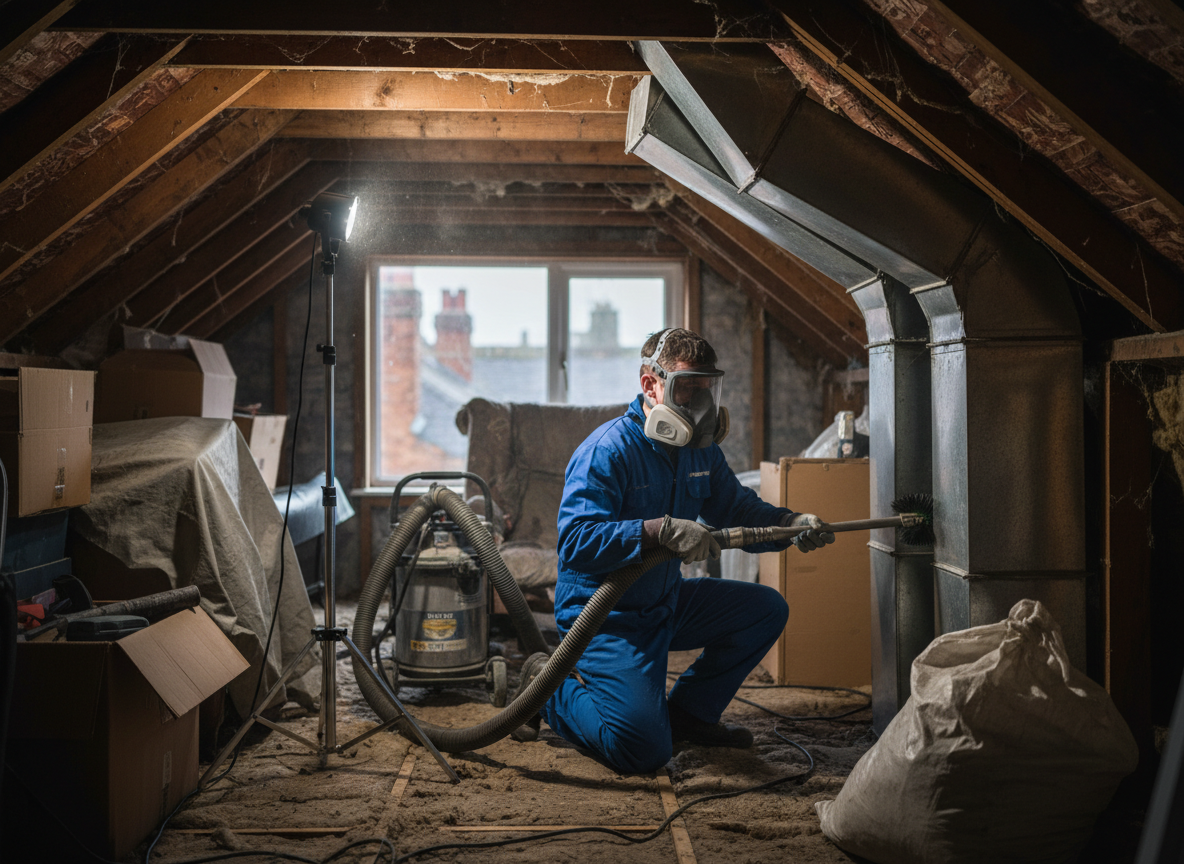
Manchester NH homes built before 1980 often have attic ducts running through unconditioned space with minimal insulation. Over decades these lines collect fiberglass particles, rodent debris and construction dust that standard floor-level cleaning cannot reach. Accessing the attic requires careful navigation around knob-and-tube wiring and old plaster ceilings that can crumble if disturbed.
Winter temperature swings in the Manchester area cause warm house air to rise and condense on cold metal ducts. This moisture mixes with accumulated dust to form a sticky film that restricts airflow and feeds mold growth. Proper cleaning here means using negative-air machines with HEPA filtration while sealing off the living space below to prevent particles from drifting into bedrooms.
We always inspect for disconnected or crushed flex duct sections common in Manchester attics where contractors once ran lines around roof trusses. These breaks allow conditioned air to leak into the attic, raising heating costs and pulling attic dust back into the system. Repairs are noted on-site before any cleaning begins so homeowners see exactly what needs fixing.
After vacuuming, we use rotating brushes sized for the duct diameter and follow with a sanitizer fog only when visible microbial growth is present. Every register is removed and cleaned separately because attic runs often terminate with undersized or painted-over grilles that homeowners overlook.
Technician insight
In Manchester the thing that catches most people out with attic duct cleaning is how often the old flex duct has sagged or pulled apart behind insulation batts, so the real restriction is never visible from the registers.
Disconnected Flex Run in North End Attic
Homeowner noticed weak airflow from second-floor vents. We found a flex duct that had separated at a joist hanger, dumping conditioned air into the attic. After reconnecting the line and cleaning the full run, airflow returned to normal and the family reported even temperatures upstairs again.
How it works
- 1
Attic Access and Safety Setup
We locate all attic entries, protect flooring with drop cloths, and set up containment to keep debris out of living areas.
- 2
Negative Air Machine Placement
A HEPA-filtered vacuum is connected to the duct system to create constant negative pressure before any brushing starts.
- 3
Mechanical Brushing and Vacuuming
Rotating brushes sized for each duct run dislodge debris while the vacuum pulls material out of the attic lines.
- 4
Register Removal and Final Inspection
All registers are taken down, cleaned, and reinstalled after we confirm airflow and check for remaining blockages.
Pricing
Cost depends on number of runs, attic accessibility, and whether repairs are needed; we provide an upfront quote after the inspection.